
Gaussian splat to textured mesh
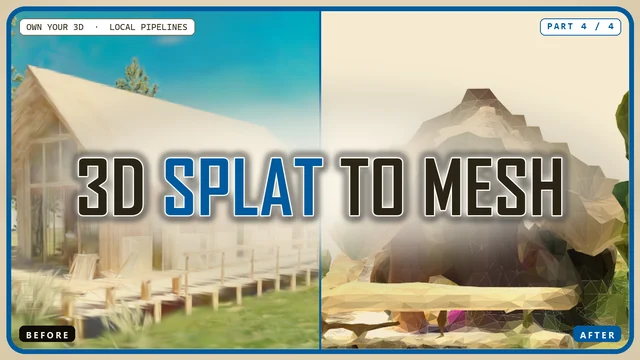
A trained Gaussian splat becomes a solid, textured .glb you can open in Blender, measure, edit and print. Every step runs on a CPU in about 93 seconds.
The code
Public, no email needed. Read it, fork it, run it, break it.
splat_to_textured_mesh.pyThe nine-function pipeline, start to finish.
The data and the reference output
Too big to paste out of an article, so tell me where to send them.
cabin_in_the_forest.plyThe trained splat, 84,528 Gaussians, 20 MB.cabin_textured.glbThe finished mesh, so you can check your result against mine.
Where should I send them?
One email, and the download links appear right here. You also get them in your inbox so you can come back to this any time.
Here they are
Yours to keep. Run the pipeline on this scene first to reproduce every number in the article, then point it at something of your own.
The same links are in your inbox. If nothing arrives, check spam, then mail me and I will send them by hand.

3D Data Science with Python
Building Accurate Digital Environments with 3D Point Cloud Workflows
This kit is one pipeline. The book is the discipline underneath them: 690 pages from the Python foundations through point cloud processing, meshing and the engineering that keeps a 3D workflow standing up in production. If the script above makes sense and you want the structure they came from, that is where it lives.
See the book or buy it on O’Reilly
Dr. Florent Poux
Founder and Lead Instructor at the 3D Geodata Academy. 15+ years on the automation of reality capture, from point clouds and photogrammetry to spatial AI, and 1,700+ citations across 60+ peer-reviewed publications.
I write on Medium · LinkedIn · YouTube · About · ORCID
These are the materials for Gaussian splat to textured mesh, one of the tutorials I publish on Medium and on learngeodata.eu. Every kit lives at learngeodata.eu/materials/.
