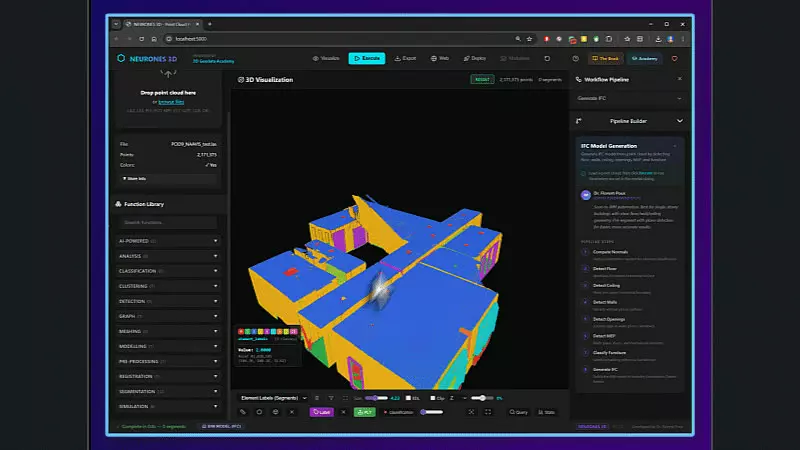
Team training
Your team learns to build it, on your stack and your data.
- Engineers who can run the pipeline without me
- Reproducible workflows and written internal standards
- A reference project on a real use case
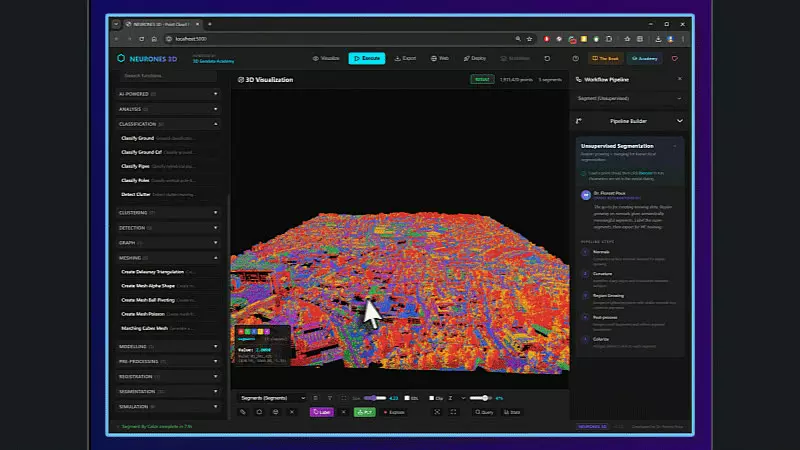
You’re building production-grade systems (reconstruction, point clouds, 3D deep learning, deployment). You need internal standardsand a shared technical language.
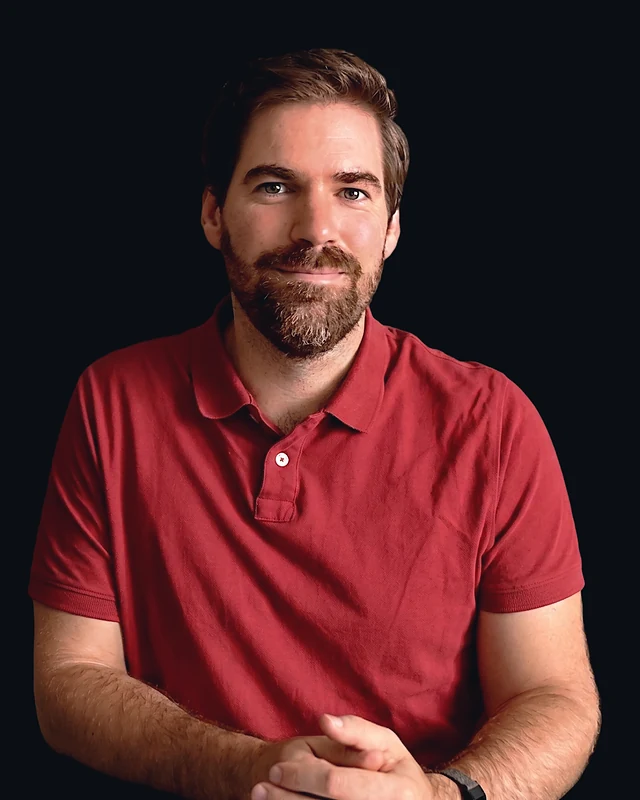
Founder, 3D Geodata Academy · PhD · O’Reilly author
Enterprise engagements are scoped and delivered by me. Not handed to a delivery team, not fulfilled from a template. You get the person who wrote the book, built the software, and has spent fifteen years moving 3D data from field capture to systems running in production.
That is the whole proposition on this page. Not a vendor and not a course licence, but an expert inside your problem long enough to leave a system that works and a team that can run it without him.
I read every message myself. No templates, no reply bots.
Pick by the kind of help you need. Duration follows from the scope.
Your team learns to build it, on your stack and your data.
For a team already building that needs the expensive calls de-risked.
We build the system together, so your team can carry it afterwards.
No proposal before we have spoken. The first call is fifteen minutes and it is a conversation about your problem, not a pitch.
Your goal, your constraints, the data you hold and the deadline. If I am not the right person for it, I tell you on the call.
What we would do, what you get, who does which part, how long, what it costs. In writing, so you can circulate it internally.
Where the technical risk is real we start with a short paid pilot on your data. Where it is not, we go straight to kickoff.
Working increments your team reviews as we go, with a support channel between them. Never a black box that opens at the end.
The repository, the documentation, the internal standards, and a team that can run and extend it without me.


Researcher
Technical University of Madrid​
ML Engineer
PropTech Startup​
Civil Engineer → Spatial AI Lead​
A working system built on your use case. Prototype, pipeline, MVP or internal tool.
I have lived the full chain, from field surveys to research to deployed products. Four principles carry into every engagement, whichever scope you pick.
We start from the deliverable you have to hand over, and walk backwards. Skills, architecture and tooling fall out of that decision rather than driving it.
Reusable workflows on open toolchains. Your next project does not collapse the day a vendor changes its pricing or its licence terms.
Checkpoints, review loops and a direct channel. Fast progress, without your team quietly becoming dependent on the person teaching them.
Automation on the analysis, the reporting and the pipeline glue. Never on the calls that need somebody who understands the data.
The format adapts to your security constraints and your team setup, not the other way round.
Platform access, live sessions and a private support channel.
Online preparation, then 3 to 5 days on site, then follow-up support.
Delivery from three consecutive days, at your premises.
Built in research, refined through real systems, and delivered under the constraints your team actually operates under. Every line below is checkable.
Short answers. If you need specifics, we cover it on the diagnostic call.
You describe the goal, the constraints, the data you have, and the deadline. I ask enough to work out whether what you have is a training problem, an architecture problem, or a build problem, and which of the three scopes fits.
You leave with a recommendation whether or not you go further. If I am not the right person for the job, I say so on the call rather than in a proposal.
There is no fixed price, because scope is what drives it. The three scopes are team training (2 to 8 weeks), R&D guidance (ongoing), and custom and co-development (6 to 24 weeks), and the delivery format moves the number too: remote, hybrid, or on site.
After the 15 minute scoping call I send a written proposal shaped around your constraints and the outcome you need. Per-seat prices for the self-serve programs are published on the pricing page and in the PDF catalogue; enterprise work is quoted per engagement.
Yes. That is the team training scope: 2 to 8 weeks, run on your stack and your data, with checkpoints and code review, ending in a reference project the team built together.
It covers both capacity building for a team that is new to 3D AI and levelling up one that is already working in it. Group size is agreed at scoping and kept small enough that everyone actually gets their work reviewed.
It depends which scope you pick. In custom and co-development we build it together, my hands on the hard parts and your team on the rest, which is what makes the result maintainable. In team training your team builds and I teach and review. In R&D guidance your team builds and I advise.
What I do not offer is fully outsourced delivery where your team never touches the code. That is the version that stops working the day I leave.
No, and the difference is deliberate. Team training builds the capability inside your team. Custom and co-development delivers a working system, but we build it together so your people can extend it once I am gone. R&D guidance is advisory: I review architecture and pressure-test roadmaps.
In all three the measure is the same. You should need me less next year, not more.
You do. Code we write together, models trained on your data, and the data itself are yours, with no claim from me on any of it.
The teaching material and the Neurones 3D Software Suite stay mine and come with a licence to use them inside your work.
Anything from one R&D lead to several teams. A founder or a lone specialist is usually R&D guidance. One team with a real internal use case is team training or co-development. Several teams, or a programme spanning them, is a longer co-development engagement with a capability plan over the top.
Sizing it is what the scoping call is for.
The scoping call is usually within a week, and the written proposal within a week of that. Start dates depend on the current book, and a short pilot can normally begin sooner than a full engagement.
If you are working to a hard deadline, say so on the call. I will tell you honestly whether it is reachable rather than quote for it and hope.
All three. Remote is platform access, live sessions and a private support channel, which suits distributed and international teams. Hybrid is online preparation, then 3 to 5 days on site, then follow-up support.
On site starts from 3 consecutive days and is the right call for sensitive data, complex environments, or when you need a whole room aligned quickly.
Yes. Delivery adapts to the constraint. On-site engagements start from 3 consecutive days, and hybrid is the usual answer when data cannot leave your network.
The toolchain I teach is local-first by design, so point clouds and trained models do not have to reach a third-party cloud at all. NDAs are normal and I sign yours.
Reach out for tailored support, or book a call to have more information about new courses .
Send us your questions and ideas and we will define the best path forward
To provide the best experiences, we use technologies
like cookies to store and/or access device information.
Consenting to these technologies will allow us to process data
such as browsing behavior or unique IDs on this site.
Not consenting or withdrawing consent, may adversely
affect certain features and functions.
Notifications