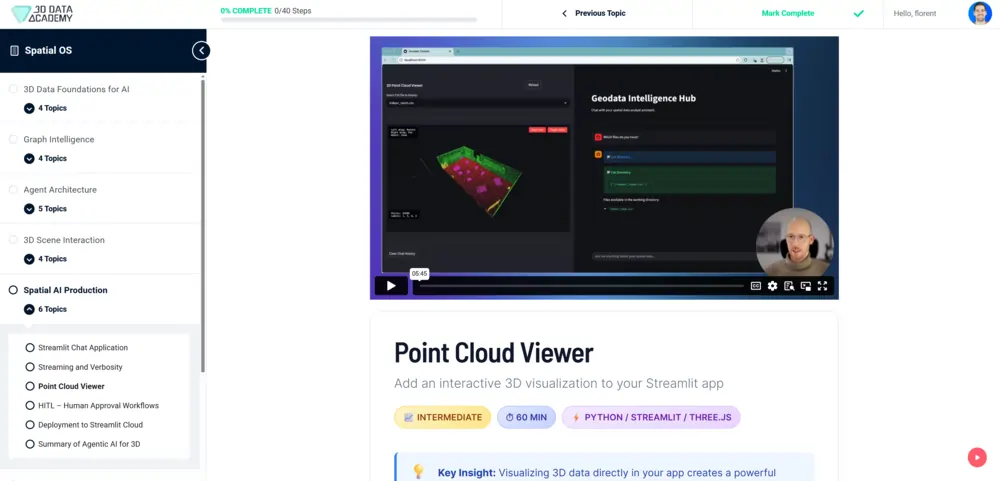
Six months ago, "process this point cloud" was enough. Today, your clients are asking for autonomous agents, spatial RAG, and AI-powered digital twins. The gap between where you are and where the industry needs you is growing every week.
I built SpatialOS because I watched brilliant engineers — people with PhDs, 10+ years of experience — get passed over for projects because they couldn't build complete autonomous systems. This is the curriculum I wish existed when I made my own leap.
You've taken courses. You can process point clouds with Python. You can segment, classify, and reconstruct.
But your clients aren't asking for processed point clouds anymore.
They're asking: "Can I talk to my building?"
They want spatial agents that answer questions about their facility. They want autonomous pipelines that detect changes without human intervention. They want LLM-powered digital twins that their team can query in natural language.
And the gap between "I can process point clouds" and "I can build autonomous spatial systems" isn't something you close with YouTube tutorials or ChatGPT. It requires a complete system — from data to graphs to agents to deployment.
That's the gap SpatialOS was engineered to close. Not by teaching you more tools — but by giving you the complete operating system for building autonomous spatial intelligence.
"We are at a glorious crossroad. The days of manual point cloud processing are fading. The future
belongs to those who can engineer Autonomous Systems. I built this curriculum not just to teach
you Python, but to give you the keys to the engine room of the Spatial Web."
— Florent Poux,
Ph.D.
Own 100% of the Source Code. No API dependency. No vendor lock-in. You control the intelligence.
A modular architecture designed to integrate tomorrow's LLMs and Sensors seamlessly.
The industry demands Autonomous Digital Twins. Be the one who builds them.
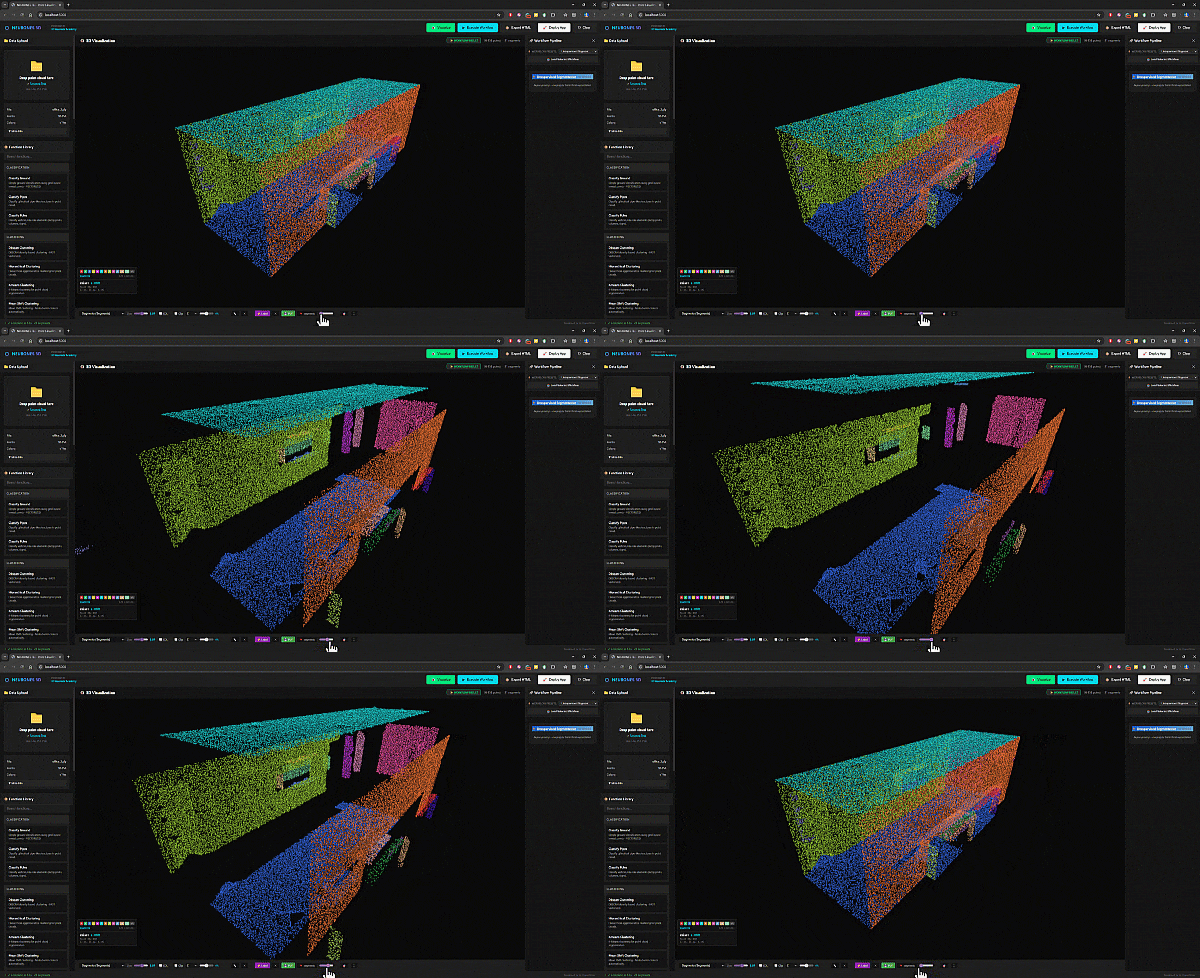
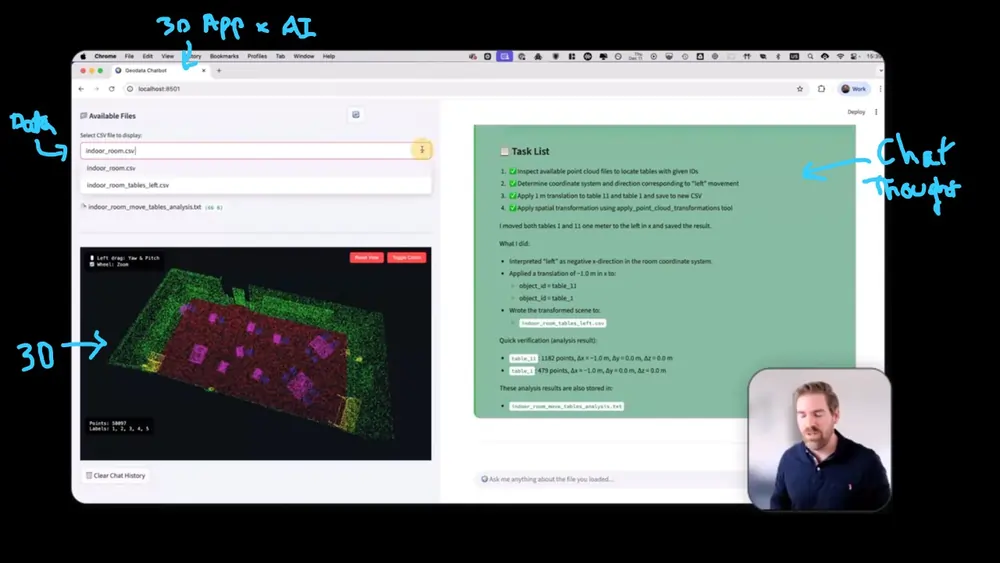
You will build and deploy a production-ready 3D AI Agent Application with a full Chat Interface.
Imagine handing your client a URL where they can chat with their facility. "Show me the damaged pipes." "Calculate the volume of room B." The agent responds visually and analytically. This is what you will build.
Not just a course. An Operating System for your career.
Autonomous Agents. LLM
Workflows. Impact-Driven Engineering.
A battle-tested learning system engineered over 10+ years of teaching MS.C, Ph.D students, engineers, researchers, and professionals.
Build-to-Deploy (B2D) is the pedagogy I developed from a decade of mentoring experts. Every lesson follows a proven structure:
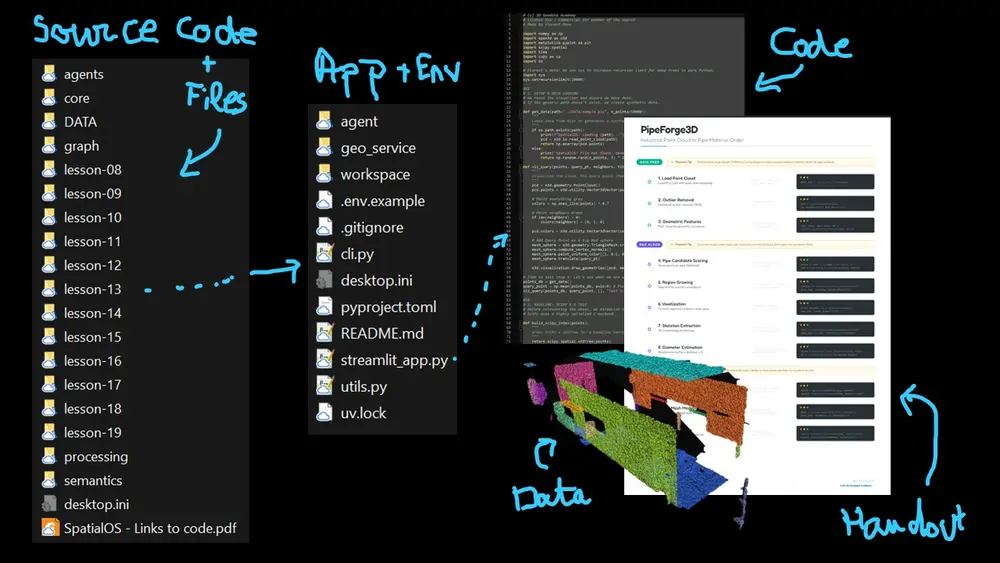
No black boxes. No API keys. You own everything. We hand you the complete tech stack:
This isn't another course you'll start and abandon. It's an operating system with a clear 12-week roadmap. My students invest 6-10 hours per week — less than the time most engineers lose debugging fragmented knowledge from scattered tutorials.
The question isn't "Do I have time?" It's "Can I afford not to invest these hours while the industry reshapes around me?"
Compared to what? A university semester costs €5,000-15,000 for theory. Corporate training runs €1,500 per person, per day — three days and you've already exceeded the Innovation Stack. And trial-and-error? That's 6-12 months of your salary while you figure it out alone.
One freelance project with these skills: €5,000-15,000. One corporate training contract: €15,000-50,000. Salary increase from Spatial AI specialization: €10,000-30,000/year. Breakeven is your first project.
Then you get every penny back. 14-day money-back guarantee. No questions asked. And you keep everything you've downloaded.
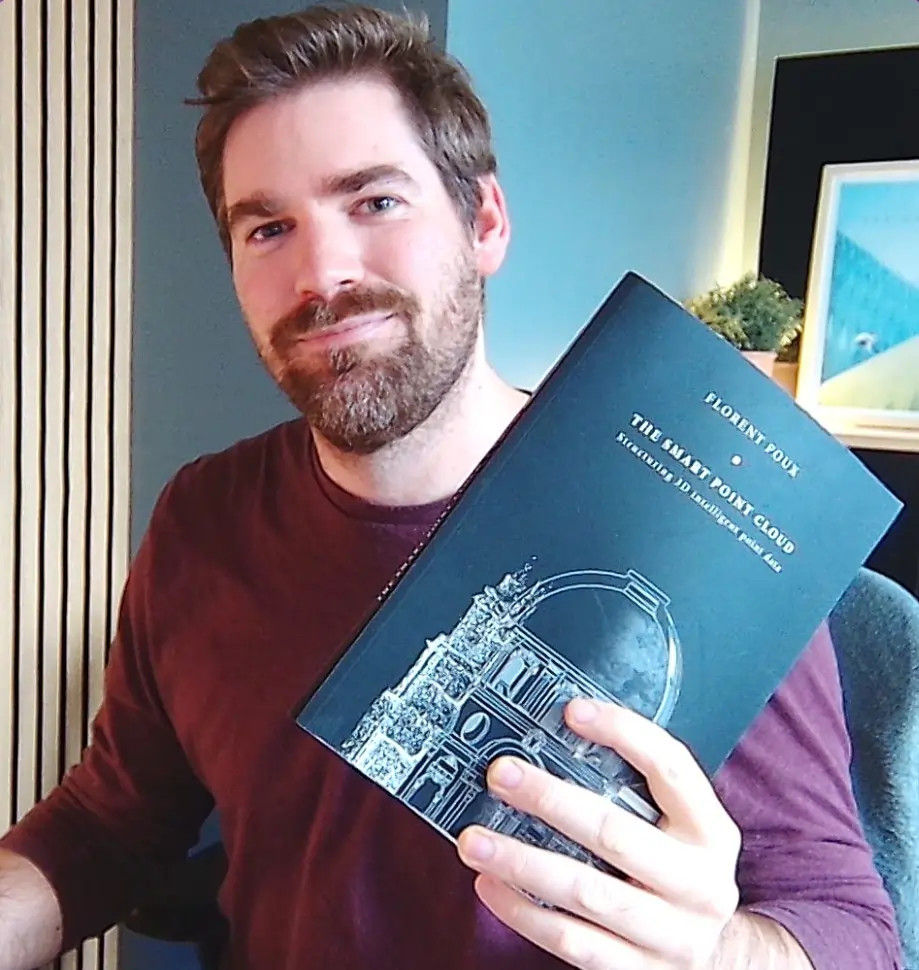
Why am I confident? Because this is the exact system I used to go from field engineer to PhD to Professor to Innovation Director to O'Reilly Author. Same principles. Same architecture. Proven across 2,500+ students.
ChatGPT will give you code that runs. It won't teach you when deep learning fails and classical methods win. It won't show you how to validate quality in production. It won't explain why your pipeline works on test data but breaks on real-world scans.
That's judgment. That's system design. That's what separates architects from prompt engineers. Use AI to accelerate implementation. Use SpatialOS to develop the judgment AI can't replicate.
Correct — full content is ready Q1 2026. That's exactly why the founding price exists. You're locking in the lowest price this program will ever have, with lifetime access to every future update, module, and DLC I release.
Early students shape the curriculum. Your feedback directly influences what I build. That's a feature, not a bug.
2,500+ professionals across 42 countries. Here's what some of them shared.
"Florent's courses transformed how I approach 3D data projects. Within 3 months, I went from basic point cloud processing to leading my company's spatial AI initiative. The code templates alone saved me weeks of development time."
"The depth of content is unmatched. I've taken courses on Udemy, Coursera — nothing comes close to the practical, production-ready approach Florent delivers. My PhD research accelerated by months thanks to the techniques and code I learned here."
"I used to spend days on tasks that now take hours. The 3D Segmentor OS gave me a complete framework I use on every project. I landed a €25K consulting contract within weeks of finishing the course."
"What separates Florent from every other instructor is that he's actually built production systems. The code works. The architectures are real. The support is genuine. This isn't theory — it's a playbook for building things that matter."
Most instructors teach from one angle. Florent built the complete pipeline — from field operations to spatial AI breakthroughs, from startup founding to million-euro funding, from research publications to industry deployment.
"I don't teach what I read in papers. I teach what I used to win contracts, secure funding, publish research, and build companies. SpatialOS is the operating system I wish I had when I started."
Basic Python knowledge is sufficient (if/else, loops, functions, lists). Everything else — from LangChain to scene graphs to Streamlit deployment — is taught from first principles with step-by-step code walkthroughs.
Following the structured roadmap at 6-10 hours per week, expect 8-12 weeks to complete the core modules. You have lifetime access, so work at your pace. Some students finish faster; others take their time with the DLC bonuses.
Full course content is rolling out Q1 2026. Founding members lock in the lowest price and get immediate access to available modules, with new content delivered as it's released. You also get all future updates at no extra cost.
Windows, Mac, or Linux with 16GB+ RAM recommended. All tools are open-source or free-tier: Python, Open3D, LangChain, Streamlit, and more. No paid software licenses required. Everything runs locally — no cloud dependencies.
Yes. Corporate packages with team licenses, completion reporting, and custom invoicing are available. Book a strategy call to discuss your team's needs.
14-day money-back guarantee. If you're not satisfied for any reason, request a full refund within 14 days — no questions asked, keep all downloaded materials.
Payment plan options can be discussed. Book a quick call and we'll find the right arrangement.
You've read this far. That tells me something about you.
You're not satisfied with scattered skills. You want complete systems. You want to build things that matter — autonomous agents, spatial digital twins, production-ready AI pipelines.
The spatial AI landscape won't wait. Six months ago, most engineers hadn't heard of spatial RAG. Today, it's becoming a client requirement. The window for early movers is closing.
Keep collecting random tutorials. Hope the pieces connect eventually. Watch colleagues get the projects you wanted.
Master complete autonomous systems in 12 weeks. Deploy production-ready spatial AI. Become the architect your industry needs.
Still deciding? Book a 15-minute strategy call — no pressure, just clarity on whether SpatialOS is right for your situation.